Saturday, October 23, 2010

Science fiction, philosophy or ... teology ? 2001 — A Space Odyssey

As usual, it is extremely hard to write a review about the book or a movie that deserved and received thousands of reviews. So it was with Arthur C. Clarke's2001: A Space Odyssey” for me. Yet there are some aspects of this novel, that seems to be overlooked by many.

First let me shortly recall, that the novel is less well known in the popular culture than Stanley Kubrick's famous movie, that has been and continues to be — one of the best movies ever done. I'm sure not many of my readers would disagree. However, both the movie's screenplay and the novel were created almost concurrently, and the novel was published after the film public release. So, while the movie's visual and verbal narrations have their own life and are great achievement of the great writer and the great filmmaker — the narration of the novel extends the main message of the film and goes much deeper.

The final sequences of the famous movie show the transformation of the main character into an older and older person, and then upon the influence of the monolith — to the child. The very last scenes reveal the symbolic „return” of the child to the earth or its orbit.

The novel is more textual at its climax: we know that the mind and memory of the main hero are being transformed from his physicality into a „mind” which, while still incorporated in the child, is clearly the omnipresent mind with the deep insight and awareness about everything it/he wants. In the last scenes of the novel the child (mind) comes back to the earth at the right moment, at a brink of a nuclear war and saves the world by destroying the warhead of death.

The last sentences of the novel read:


„He had returned in time.

Down there on that crowded globe, the alarms would be flashing across the radar screens, the great tracking telescopes would be searching the skies - and history [as it had hitherto been known] would be drawing to a close.

A thousand miles below, he became aware that a slumbering cargo of death had awoken, and was stirring sluggishly in its orbit. The feeble energies it contained were no possible menace to him; but he preferred a cleaner sky.
He put forth his will, and the circling megatons flowered in a silent detonation that brought a brief false dawn to half the sleeping globe.

Then he waited, marshalling his thoughts and brooding over his still untested powers.
For though he was master of the world, he was not quite sure what to do next.

But he would think of something.”


On the surface, and out of context it sounds naive, but when you read the book — it is not. Clarke's parable is in fact a philosophical speculation on the idea of linking religion with external intelligent life. While I'm not in favour of such speculations, it is hard not to see the elegance and wisdom which Clarke puts into his allegory. Just muse over the penultimate sentence: „For though he was master of the world, he was not quite sure what to do next” ....

Monday, September 27, 2010

The Neuro Revolution - Two reviews in one post

I have just read Zack's Lynch „The Neuro Revolution”. As before — seems to me the full review will come in due time :-)

However, I must say, that I have very mixed impressions. And I must say frankly, it is quite bombastic, utopian book with very little knowledge about the field itself ...

It is perhaps characteristic, that I found the similar tendencies of utopian thinking in this book, as it was in Lakoff's „Political Mind”...

If there is some value in reading the book, it is in really good number of references to significant events and other books and other people of the field...

Going to Munich today... No more time ....

Two weeks later:

I honestly tried to add a bit more about the book, but finally I didn't find it reasonable...

Particularly, in the light of another book related to brain science I read ("Shallows"), I found Lynch's book quite naive and utopian...

When he writes about such things like neuroenablers, oxytocin or concepts like neuroteology or neurocosmetics, he does not deliver any deeper information, but a kind of superficial hype of pseudo-science...

See, as an example, how he writes about the potential of neuroscience for business and society:

„In a neuro-society, corporate wealth will flow in a more lateral way, decreasing the gap between the haves and have-nots bolstering the middle class and reducing poverty. That development will add to our social capital making prosperity last longer. Neurotechnology will also provide new tools for management, it will become less seed of the pants and start being something of the science.(...) But many people who get to be managers, are often the fiercest competitors and they don't always have a good emphatic skill set. In the future more people will have better tools in training, perhaps in neurofeedback even in exquisitely targeted neuropharmaceuticals ....”


Not only Lynch's visions are utopian and inhumane but also scary ... All of this seems to be very strange, even more, when one discovers how active Lynch is on the public scene and how high is his influence (See his blog...)

So what is the book's value? Is there any?

As I wrote before — there is some value in it as a source or collection of some very good references.

For example, thanks to the book I found an interesting TED talk by Jill Bolte Taylor and discovered for myself great scientist Vilayanur Ramachandran. The another reference was to an article about Neuropsychology of Religious Experience.

Some books, referred to by Lynch, like Steven's Mitchen:
The Singing Neanderthals: The Origins of Music, Language, Mind, and Body
, „Why We Believe What We Believe: Uncovering Our Biological Need for Meaning, Spirituality, and Truth” by Andrew Newberg, or „Proust was a Neuroscientist” by Jonah Lehrer will certainly be on my next-reading list !

So, I suggest not to read it from cover to cover but to harvest it for indeed quite good references :-)

Friday, September 24, 2010

The utmost surrealism in a realisticly told tale about unreal world ...

I just finished "Nostromo" by Joseph Conrad...
I do not know what to say. This is ulitmate book, the ultimate literature experience.
Through all the book the shiver of someting out-of-this- earth pierced my ears and my mind...

I hope, I will write a true review, but I just wanted to tell you now that this great book is a must...

Saturday, September 18, 2010

Victor Hugo on human nature, history and philosophy ...

I'm slowly coming back to my regular writing of reviews for the books I read and/or listen to.

Don't ask me please what has caused this, almost 2 months long, silence. There were reasons, but I wanted to keep them away from digital world, as all the thoughts and feelings caused by them ...

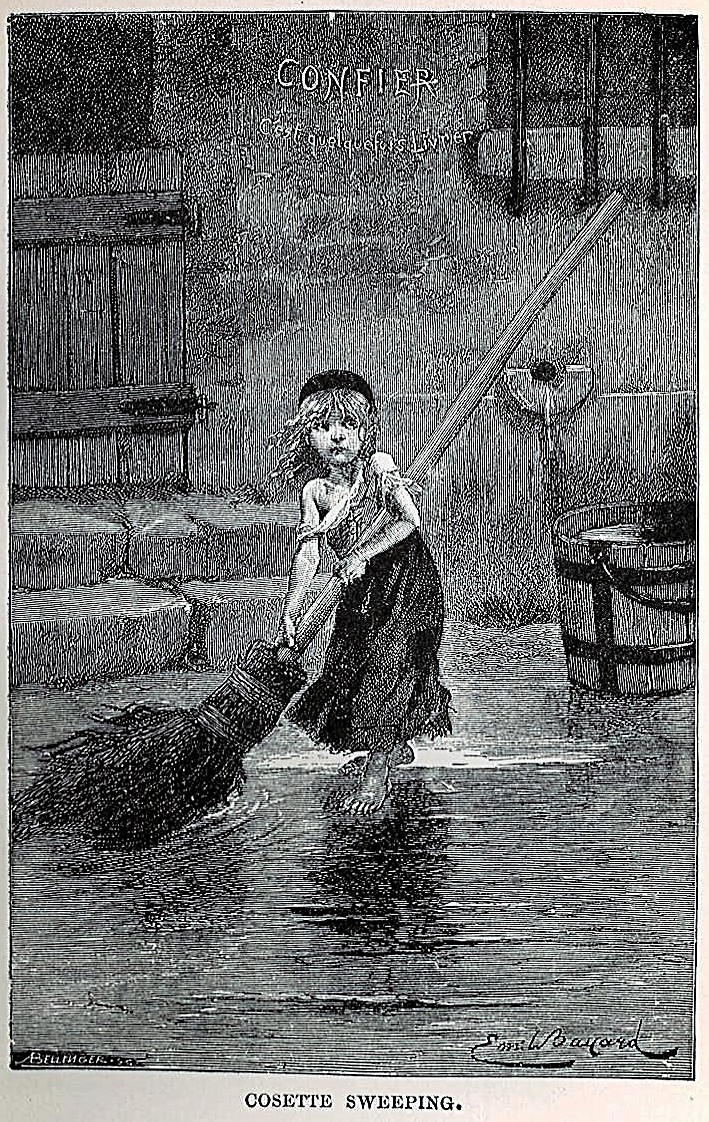
So my first very late review is for Victor's HugoLes Miserables” which reading I shortly reported here.

After „Notre-Dame de Paris” (here and there) I knew that Les Miserables will be THE book of my 2010 reading. And it was. It seems that writing any new review for the masterpiece of literature, which received thousands of excellent reviews, makes little sense. So it is, and let me only very shortly to tell you what is a historical fiction which plot starts in 1815 in France and lasts for about 20 years. The main story of the novel is about ex-convict Jean Valjean and his attempts of expiation and redemption against all odds. It later evolves into a love story in the second generation after him, however, placing his personage always in the context.

Even if it was written in XIX century, the storytelling in the novel is excellent and is still superior to so many later „epoch works” ....

However, I want to stress some other aspects of this enormous (1900 pages) work. It contains a lot of deep philosophical passages about the nature of law, ethics, politics, religion and French history. Set in one of most tumultuous periods of the country history (like defeat of Napoleon at Waterloo or Spring of Nations), it examines the nature of historical and philosophical dispute between royalists and republicans. And in all these, philosophical, historical, sociological analyses, Hugo shows incredible level of maturity and, I could say, professionalism. He does not merely „philosophize" — he goes deeply into the nature of the problem, yet his language remains simple and direct:

„Conscience is the chaos of chimeras, of lusts, and of temptations; the furnace of dreams; the lair of ideas of which we are ashamed; it is the pandemonium of sophisms; it is the battlefield of the passions. Penetrate, at certain hours, past the livid face of a human being who is engaged in reflection, and look behind, gaze into that soul, gaze into that obscurity. There, beneath that external silence, battles of giants, like those recorded in Homer, are in progress; skirmishes of dragons and hydras and swarms of phantoms, as in Milton; visionary circles, as in Dante. What a solemn thing is this infinity which every man bears within him, and which he measures with despair against the caprices of his brain and the actions of his life! ”

And the last, but certainly not least matter: Hugo created the fictional world that still lives in us and in our culture. See around and you will quickly find Jean Valjeans, Fantines, Javerts, Cosettes, or little Gavroches. In operas, movies, theaters and songs... It is enough to remember this one ...

[the post finalized in Beavais, France in a cafe in front of monumental XIII century cathedral]

Friday, August 27, 2010

Long backlog of reviews ...

For reasons I want to keep out of digital world, I was unable to keep posting reviews of books that I read recently. So, the pile is composed of:

Victor Hugo — „Les Miserables”
Sven's Birkets - „Guttenberg Elegies”
Tatiana Rosnay - „Sarah's Key”
George Lakoff - „Political Mind”
Arthur C. Clark - „2001: A Space Odyssey”

and... currently reading Marek Hartel's "The Book of Abraham" and listening to Conrad's Nostromo ....

I hope I will manage to review each item from my list soon ....

Mirek@Stockholm

Friday, August 13, 2010

The past that haunts the present - Sarah's Key

I have just finished Sarah's Key by Tatiana Rosnay. Amazing, enchanting yet sad and tragic book. For another tragic reasons I want to keep me out of digital world, so I will not write a review today. Time will come and I will ...Maybe

Saturday, July 31, 2010

Brains, Heart and Courage - my holiday's reading

There is a book, the book that belongs to the realm of great literature, that shows and leads us in our striving for more knowledge and understanding, for deeper love and emotions and for stronger braveness in our life.

Its author tells a good story, fascinating for some us, naive for the rest, but the story that shows, without ostentation and cheap morality how we can find these virtues. They lie inside us — always in the depths of our souls, and no one can truly give them us, if we don’t start believing we can get them.

And he teaches that there are people and situation that can ignite, even if by a substitute, the fire of brains, heart and courage. However — they can ignite ONLY , never truly GIVE them to us.

The book makes also a case about humbugs and posers, and says, that sometimes they can have some merit. Contrary to the traditional thinking, and somehow against the common sense — the merit of some humbugs is in promoting good and welfare. Of course only if good is the essence of their humbuggery, not the evil...

And the book says much more; how a pauper can truly become the leader, a coward — the headman, and how a strong desire to live a normal real life among close family and friends and the resignation from splendours is, at the end, rewarded ....


This author is Lyman Frank Baum. This book is The Wonderful Wizard of Oz published in 1900....

Some used to say that the book was politically motivated, and that its characters ridicule some political figures. I don’t buy such interpretations.

The story for our children and grandchildren but not a childish fairy tale at all....

It was my holiday reading this year...

Sunday, July 18, 2010

Close Listening by Sven Birkerts — What is the problem with audio books ?

I was so deeply moved by a chapter of Sven's Birkerts „The Gutenberg Elegies” named „Close Listening” that I decided to commit a post — just about this chapter. As for the book itself, I hope to finish and comment on it during holidays, i.e. next week.

It is apparent, from the first sentences of the chapter, that Birkerts is against audio books. He gives a number of strong arguments. Let's see them here....

Passivity of audio books:


„Books, for me, have always been about covers and pages and grappling with the syntactical rigors of stationary prose. The passivity of listening seemed to me on a par with the passivity of television watching. How could it fail to reduce any work of merit to, at best, a companionable blur, a string of easy cadences in the ear?”

Confusion of experience.

He criticises the special effects that are sometimes added to the recordings (calls them tacky effects); but was is more important criticism is the confusion of our physical experience during listening, experience of driving, walking, commuting with the imaginative world of the story we listen to.

Limitation of the medium.

Sven maintains that certain literature is well perceived only through text:


„Our more serious literature incorporates levels of difficulty — in narrative sequence, referentiality, syntax, and linguistic density — and presupposes a reader who is free to hover over a phrase, reach for a dictionary, and dart back.”

Irrelevance of the recording pace to the text.

Sven gives examples, where the pace of narrator reading, being regular and uniform, was completely irrelevant to the meaning of the text. Descriptions, dialogues are usually fine, but when a book turns into some philosophical conjectures — the same pace is just unbearable:


„We don't just speed a thought through our neural network — we inhale it, hold it, wait for it to send ripples through the whole of our being. Rewinding the tape is no solution.”


Difficulty with deep reading.


„Reading, because we control it, is adaptable to our needs and rhythms. We are free to indulge our subjective associative impulses; the term I coin for this is
deep reading: the slow and meditative possession of a book. We don't just read the words, we dream our lives in their vicinity. (...) Deep listening to words is rarely an option. Our ear, and with it our whole imaginative apparatus, marches in lockstep to the speaker's baton”

Powerlessness of the listener.

Sven claims that when we hear a book we are deeply silenced by the vocal tyranny of the narrator:


„The listener is powerless against the taped voice, not at all in the position of my five-year-old daughter, who admonishes me continually, "Don't read it like that, Dad." With the audio book, everything — pace, timber, inflection — is determined for the captive listener. The collaborative component is gone; one simply receives.”

Sexless voicing.

The books read by male narrator lose the female character, if it is of importance and conversely, the manly dialogs read by a woman sound strange:


„Cheever's prose is as imprinted with his gender as Virginia Woolf's is with hers. Nor could I get past the bright vigor of the performing voice; I missed the dark notes, the sense of pooling shadows that has always accompanied my readings of the man.”

Abridgement of books kills their message.

Svens notices that too many of audio books are just bad abridgements. The arbitrary selection what to include what to leave out is usually killing the perception of the book. He gives an example of „Under the Volcano” by Malcolm Lowry:

„Lowry had meant his novel to turn like a wheel; everything in it is keyed to the concept of circularity, making chapter one absolutely indispensable . No amount of civilized gnashing by reader Christopher Cazanove could make up the
deficit.”

Multitrack sensibilities required.

Listening to audio book, requires a good deal of multitracking sensibility. This is in opposition to „single-track tasks demanded by the silent page”. What is more, it can create a shift or change in the way authors write today: „... is is not farfetched to suppose that a good part of future of literature will be bound up with the audio process.”

Despite all these remarks, the chapter ends with some positive remarks.

Sven recalls listening to James Joyce „The Dead” which he found great in the audio format. Basically he values the rendering of some short stories (by authors like Updike, Welty and Carver) in audio. He also notices that sometimes the good reader opens the deeper understanding:

„An evocative reading can capture the shifting tension that exists between sound and sense; it can unearth the overlooked sentence rhythm and whet the blade of irony. Reading is different from listening, yes, but in listening's limitations I have found unexpected pleasures.”

He ends it with these words:


„In the beginning was the Word — not the written or printed or processed word, but the spoken word. And though it changes its aspect faster than any Proteus, hiding now in letter shapes and now in magnetic emulsion, it remains. It still has the power to lay us bare.”

What do you think?

I'm passionate audio book listener, so this chapter requires me to comment and, more specifically to argue. But I will do it at some later time, maybe after your opinions...

Saturday, July 17, 2010

Reading before holidays ...

I am particularly tired and exhausted before these, 2010 holidays. This is why I'm less active on my blog...

But to tell you what's going on, here it is, shortly: after enchanting „Les Miserables” I returned to Lakoff's „Political Mind” and, in paper, to Birkerts „The Gutenberg Elegies”. Both deserve posts, and I promise to deliver them when I settle in my little cottage on the shore of Baltic sea, i.e. next week.

I will also post my recollections and records from 2010 Literary Festival in Paris.

Despite the exhaustion, I was able to create a few play lists on YouTube related to this Festival. The one worth seeing features Philip Pullman and another one David Hare.

So... Keep visiting me ...

Cheers
Mirek

Sunday, July 11, 2010

End of Seven Weeks in an another world - Les Miserables

I was reading, or to be precise, was listening to Victor's HugoLes Miserables” for the last 7 weeks. More than 1500 pages of text, rendered to more than 70 hours of fantastic story-telling (in a literal sense) by David Case (aka Frederick Davidson).

I will not write my review tonight. I'm still in the mood, despite the fact that during this reading I was also reading other books, listen to music, visited exhibitions.


I must think what and how to write. Les Miserables has caused hundreds of thousands of other reviews — so why I must write my own ? But I will wait, will wait until the incredible world created by Victor Hugo start to fade a bit, and my emotions start to sediment in the basin of forgetfulness ....


Les Miserables is so important that we almost forget it is a great book.
Who of us have not wept when little Gavroche died as a hero on a Parisian barricade of the Spring of Nations, who of us was not mesmerized when Susan Boyle sang Fantine's song... Who have never thought about a power of the qualms of conscience which had driven Jean Valjean to silent and troubled heroism; who did not imagine how beautfull was Cosetta and her mother Fantine...


That's all for tonight. If you haven't read it yet — do it please — it is more important than 1000 TV shows, more than hundreds football matches ...


I will write my regular review when the time will come....


Social Platforms for Enterprise - Enterprise 2.0 by Andrew McAfee

No one can dismiss the importance of Social Networks for the global culture. The simple saying goes: "Web connected documents — Facebook connected people". Although I'm not in favor of the role that FaceBook plays today, I cannot ignore its utmost importance for our civilisation. (For good discussion about it see here) .

When Internet brought Web to life, corporations started to use it internally and INTRANETs were born. So is today, with ESSPs - Emergent Social Software Platforms to follow Web 2.0 trends. These solutions bring a completely new setting for Knowledge Management in a corporate world. And they are the subject of the Andrew McAfee book „Enterprise 2.0. New collaborative tools for your organization's toughest challenges”.


The book is not technical at all. The author does not even try to list the software packages that deliver ESSP functionalities for today's corporations. Instead it starts from the analysis of the opportunities, often missed opportunities of the group work, goes through the definitions of Enterprise 2.0 to the concrete recommendations for corporations which would consider implementing ESSP.


On the surface we feel what the ESSPs are. We could pronounce the names of most important Web 2.0 solutions, from Wikis (Wikipedia), through social tagging (Delicious) to Social Networks (Twitter, FaceBook). But we sometimes do not notice their "free form" features like being optional, free of imposed structures, egalitarian and data format neutral. They share the important features that are best described through the acronym of SLATES: Search, Links, Authoring, Tags, Extensions and Signals. It is easy to map specific solutions available today to any of these features.

One of the bast parts of the book has the title "New Approach to Old Problems" where he applies the concept of SWT — The Strength of Weak Ties (1973 - Mark Granovetter - American Journal of Sociology) to understand better why social networks inside corporation do matter.

The concept of SWT helps to formulate the Bull's Eye theory of the importance of Social Systems. In this theory we use SN systems to maintain Strong Ties, but we also maintain Weak and Potential Ties:


These interesting considerations form Part I of the Book. In Part II McAfee considers the difficulties related to implementation of ESSPs today.

The first paradox related to their introduction is a typical Red Herring case: "I've noticed that concerns around Enterprise 2.0 fall into two broad categories: fears that people won't use the newly available ESSPs, and fears that they will". This diverting, usually "committed" by management, masks the fears of the same management. Sometimes, the fears are justified. Corporations have their secrets, they protect their information from free leaking. However, as many bright examples show (European investment bank DrKW or US Directorate of National Intelligence) there are ways to protect what is to be protected while using all benefits of ESSPs !


The second problem is that everybody wants to implement ESSPs quick, but in fact it is a task for a long period of time — true Long Haul project! McAfee lists certain qualifications that can impact the adoption, like the ability to make quick relative evaluations, understanding of the status quo and deep understanding that people are loss-averse. He concludes with the words of Gourville: „ ... to be successful companies must anticipate a long, drawn-out adoption process and manage it accordingly”


The book concludes with two great chapters. „Going Mainstream" contains a true Road Map for implementation of ESSP in a corporation. It stresses the role of early adopters (believers), and the most important challenge for management: "Communicate, Educate & Evangelize”. It also puts stress on measuring real progress rather than on calculation of ROI...


„Looking Ahead” tries to predict a future of Enterprise 2.0. The most interesting forecast the author makes is the shift from „Model 1 behavior” to „Model 2 behavior”. The concepts come from Harvard professor Chris Argyris, who in 1996 book „Organizational Learning II: Theory, Method and Practice” (with Donald A. Schön) layed out a framework for successful strategies of large organisations. „Model 1” strategy relies on the unilateral design and management of the work environment, on protection of one's position and protection of others and on grasp and control of organizational tasks. In contrast, „Model 2” strategies assume high participation and joint task control, bilateral protection of others and orientation toward growth.

Using these concepts McAfee makes the conclusive remark, that is worth to quote:


„I am deeply interested in Enterprise 2.0 not because its component technologies are novel, innovative, and powerful (although they are) and not because I believe that ESSPs will fundamentally transform how enterprises are designed, rendering hierarchy obsolete (I do not believe this will be the case).
I'm most interested in the use of ESSPs because they can help organizations move from a Model 1 to Model 2 theory-in-use. These tools can change the nature of collaboration and discussion within an enterprise, giving people the ability both to contribute their perspective to a dialogue and to inform themselves by incorporating multiple perspectives. In short, they can help organizations move from defensive to productive reasoning.”


And this quote is the best climax of the book and of my review...

The Tragedy of Ideas: How intellectuals lead history astray ...

It is often assumed that philosophical, psychological, sociological, and literary works cannot be held responsible for what later unfolds in...