Showing posts with label Classical. Show all posts

Thursday, January 06, 2011

Sense & Sensibility — Good Writership or Naiveté ?

I just finished  Jane Austen's first novel „Sense and Sensibility”. And I must say, I'm confused. It is a well written novel, no question. But the level of naivete, of narrowness of the characters' outlook of life — and what is more — of admiration of the gentry-mindedness and heroes idleness — keeps me away from writing a positive, or even any longer review. It also overshadows some passages of true irony and good comedy, that, perhaps give the true value to this book !

I'm not literary critic, so my opinion may not be taken too seriously. And I know, that many bright people (like Leo Strauss) admired Jane Austen's prose. Maybe, I could change my mind after reading some other of Austen's novel. But I still have in mind the another book of the genre and of Victorian age — Wuthering Heights by Emily Brontë. Only 30 years between them, while the difference is of enormous proportions in favour of Bronte....

Sunday, July 11, 2010

End of Seven Weeks in an another world - Les Miserables

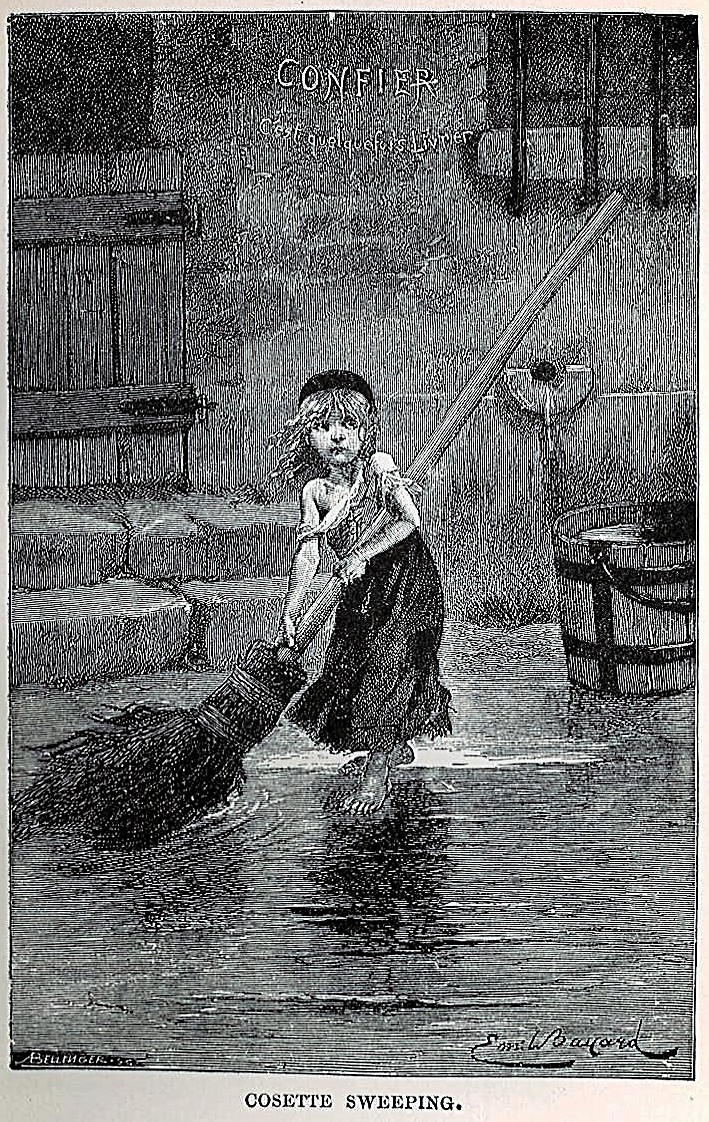
I was reading, or to be precise, was listening to Victor's HugoLes Miserables” for the last 7 weeks. More than 1500 pages of text, rendered to more than 70 hours of fantastic story-telling (in a literal sense) by David Case (aka Frederick Davidson).

I will not write my review tonight. I'm still in the mood, despite the fact that during this reading I was also reading other books, listen to music, visited exhibitions.


I must think what and how to write. Les Miserables has caused hundreds of thousands of other reviews — so why I must write my own ? But I will wait, will wait until the incredible world created by Victor Hugo start to fade a bit, and my emotions start to sediment in the basin of forgetfulness ....


Les Miserables is so important that we almost forget it is a great book.
Who of us have not wept when little Gavroche died as a hero on a Parisian barricade of the Spring of Nations, who of us was not mesmerized when Susan Boyle sang Fantine's song... Who have never thought about a power of the qualms of conscience which had driven Jean Valjean to silent and troubled heroism; who did not imagine how beautfull was Cosetta and her mother Fantine...


That's all for tonight. If you haven't read it yet — do it please — it is more important than 1000 TV shows, more than hundreds football matches ...


I will write my regular review when the time will come....


Sunday, March 15, 2009

Mahler's no programme pure music - 7th Symphony

Mahler's 7th was the first ever symphony I was happy to experience and it was live...

Today I listened to Bernstein's incredible interpretation of this unusual symphony.
What makes it so unusual then? First, that it has no "programme" characteristic to other symphonies. Mahler vigorously opposed to label it as "Lied der Nacht" (The Song of the Night).
There are no singers, no choir. Pure musical experience. How powerful, though !

There are many beautiful reviews about it, so instead of another lengthy post, I rather humbly refer you to one of them - by Henry-Louis de La Grange.

My own amazement comes from several reasons: the music is clearly "out-of-its-time". I had impressions similar to that I have when listen to Britten or even Penderecki, though the musical language is quite different. Then, the instrumentation is surprising, and gives surprising sound: cow-bells, tubular bells, guitar (!!!), mandolin (!!!) and all sound really non-trivial.

Mahler uses a lot of citations - a waltz, a serenade, a march like rhythm ....

No programme - sheer beauty - however - we could read something between the notes: the great stress and tension of the author - confirmed by what we know of his life between 1904 and 1908...

Tuesday, September 30, 2008

Music history continued ...

Richard's Fawkes book "The History of Classical Music" is fantastic introduction for all of us who are interested in the history of music, but how do not have energy to read long treatises. Fawkes book takes us on an interesting journey from the beginnings of western music, starting from mystic chants of Hildegard of Bingen, through renaissance and baroque classical music to modern music of such giants like John Cage, Karlheinz Stockhausen or Henryk Górecki.
It has also some interesting parts that describe opera music.

The book is certainly more scholar and more "popular" one than "The Rest Is Noise" (described here), but it gives a good ground for understanding the transformations of music through centuries. Sometimes, it lacks some deep details that could be interested for us, readers (I missed more information about Bach and/or Mozart), but my overall opinion is positive.

The book ends with beautiful short parable: "Yet, having started this journey with Greogorian chant, it seems appropriate to conculde with a world, that perhaphs, would not sound so unfamiliar with the devout of Dark Ages. Arvo Part, the Estonian composer, born in 1935 has his roots in chant, yet his minimalism is a distinctly XX century voice. The spiritual qualities, the spiritual message of the Westeren musical tradition is undimmed, even into XXI century..."

Sunday, September 21, 2008

The imaginary country of modern music that can not be found on a map - the end of The Rest Is Noise reading ....

The reading of "The Rest is Noise" by Alex Rose was one of the best experiences I could have in September of 2008. As I wrote in the previous post, it shows incredible connections betweenthe music and politics or the trends of troubled XX century.But it also shows that in the later part of XX century, music became less "political" and more engaged in itself - in creation of "The imaginary country that cannot be found on a map" (Debussy).
Alex Rose, shows us what makes the great music, free from politics, when he writes:"The debates over merits of engagement and withdraw [of music] has gone for centuries (...)Composition only gains power from failing to decide the eternal dispute. In a decentred culture, it has a chance to play a kind of good-father role - able to assimilate anything new because it has assimilated everything in the past".

I do not see, and I believe, the author also does not think that way - that the music CAN in fact be motivated by what happens in the world - it cannot be isolated. But, what is the great hope, thatthe music is not, and will never be played to fulfil some crazy dictator's agenda ....

I strongly recommend this book for everyone who is interested in modern music.

The Tragedy of Ideas: How intellectuals lead history astray ...

It is often assumed that philosophical, psychological, sociological, and literary works cannot be held responsible for what later unfolds in...