Showing posts with label Jewish. Show all posts

Sunday, February 26, 2012

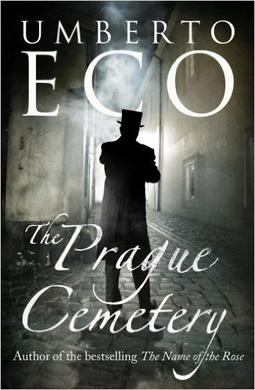
Anatomy of Conspiracy Theories — Umberto's Eco genius shines again ...

What is the mindset of conspiracy theory brewer? What kind of mental characteristic such a person has ?
Umberto's Eco „The Prague Cemetery” attempts to sketch the personalities of those who most certainly invented most incredible and ghastly tales of the turn of XIX and XX centuries.

The book reads like a novel, and those who read it „as is” may not even notice (until author afterwords) that it is rather historical book, referring to existing events, describing realy existing people. Almost. There is one exception — the protagonist of the book. It is the only true „fiction character” — and perhaps only for this character we still could call Eco's book „a novel”...

Set in Italy and in Paris, the plot describes true historical events roughly between 1850 and 1898. In Italy we met Garibaldi and learn about plots instigated by Piedmont secret police. In Paris, we witness Franco-Prussian war and the Days of Commune to see how important was the falsification of truth to gain certain political advantages. We learn about the Dreyfus affair and how it was motivated... Eco unfolds the plots about Masons and Jesuits...
And, at the book crescendo, we learn about infamous „The protocols of the learned elders of Zion”...

It was amazing experience going to Wikipedia with all that names, events and places and literally find them all! In that sense, it is true historical account of some of the most important events of XIX century.

On that specific background we observe our hero Simone Simonini. As Eco explains in afterwords, even this character has been built more like a collage of that time personalities than as a fully fictitious character.

To me, this specific construction of the book was designed to uncover the mentality of conspiracy theories creators. Eco's attributes to such people several personality traits, not necesserily all present in the same person. In our Simone Simonini we see the trait of indifference (he would create a forgeries just for money), we see the sheer hate (his deep anti-semitism led him to "protocols" and his part in Dreyfus affair), we see specific gluttony and sybaritism, and above all — we see schizophrenic personality split (during the large part of the story we do not know who is who...).
Despite all these, Eco analyses also the other motivations — as the need to justify specific political agendas, to name the one...

By all these means, Eco opens anew the old discussion, which does not loose relevancy. I still see around me people and their fantastic „stories”. Stories that sometimes are as far from the truth as day from night. Yet people believe in them, spread them, discuss them... In many „echo chambers” of the current horizon of public discourse and on the Web, the creation and spread of such tales is even more prevelant than it was in XIX century... (See e.g. Jew Watch project ...). I was completely shocked to learn the „The protocols of the learned elders of Zion” are still printed and read as „true” in many countries of the Middle East....

Above all that, as it was with all Eco's book — it is fantastic reading experience, and is beautifully illustrated. Strongly recommend...


Saturday, December 31, 2011

.„... but we still carry its genes” — reflections on David's Bezmozgis „The Free World"

I had quite special and unique impressions when I was reading „The Free World. A Novel” by David Bezmozgis. Born 1973 in Riga, Latvia Bezmozgis came to Canada as a child. Well educated in both Canadian and American universities, Bezmozgis debuted in 2004 with his „Natasha and Other Stories”. He is now well known filmmaker and writer. As it was for his debut, his new novel (published this year, 2011) „The Free World” reflects the experiences of Jewish refugees from former Soviet Union. The action of „The Free World” is set mostly in 1978 Rome with some episodes in Vienna and frequent comebacks to then soviet Latvia. Three generations of Krasnansky family of Latvian Jews, who escaped from USSR come through the painful process of getting accustomed to the free world. They look at this new world with their eyes which not long ago looked at the world through communist lenses. And to me this transformation, this change is the essence of the book. They are in the free world, but, to various degree they still „carry communist genes”.
On the other plane the book is very nostalgic and sad. There is a notion and a feeling of specific „uprootedness” the characters experience in Italy. A lot of thoughts about the feeling of Jewish refugees to the state of Israel, so often painted by remnants of soviet propaganda residing in their heads... Their specific reactions (Jews on one side of their souls and former soviets on the other...)  to swift change of Popes (this was the year of Paul VI, John Paul I and John Paul II)

Reading (i.e. listening to incredible voice of Stefan Rudnicki) the book I had that specific feeling of listening to debutant, although that does not make it worse than any other books I recently read...

BTW, here is 8 minutes long recording of Bezmozgis reading from the novel...

Published in the last hour of 2011...

Sunday, January 30, 2011

„Night” by Elie Wiesel

It is a book that, just after I started reading, made me quickly to relinquish it. And I had real difficulty to return ...

Written by famous Elie Wiesel, the Holocaust survivor and Nobel prize winner, „Night” is very realistic account on the tragic fate of Jews during Shoah. But the realism it is written with is almost unbearable.

Don't take me wrong, though. I do not mean I could not read it or that it is bad book. But to apply a typical slogan „Great Book” or „Nice reading” is in fact an act of betraying the author ...

In short, it describes the events since the beginning of the war that happened in Sighet, through the liquidation of Ghetto in that Romanian town. We are taken on a journey to Auschwitz, Buna (Monowice —Auschwitz III) and to Buchenwald. Despite the fact that the fate saved the narrator of the book, he lost his faith in G-d, in humanity and in himself. As more about the book can be found in the good Wikipedia article, I will not elaborate on it more...

In fact, when I finished it I was in a kind of trauma for several hours...

See the ending of it:

„At six a clock that afternoon the first American tank stood at the gate of Buchenwald. Our first act as free men was to through ourselves onto the provisions. That's all we thought about. No thought of revenge or parents, only of bread. And even we were no longer hungry, not one of us thought of revenge.
(...)
One day when I was able to get up I decided to look at myself in the mirror on the opposite wall. I had not seen myself since the Ghetto. From the depths of the mirror, a corpse was contemplating me. The look in his eyes as it gazed at me, has never left me...”

Paris, January 30, 2011

Saturday, December 11, 2010

A Tale about Joy and Suffering ...

You will not find this book in English. Written in Polish was most surely not yet translated to other languages. It is even hard to find any information about it author, Pinchas Menachem Joskowicz on the net. Some short posts were mostly related to his recent passing away in Jerusalem. The book can be found on Google Books though.

„A tale about Joy and Suffering” (In Polish: Opowieść o Radości i Cierpieniu) is the autobiography of Joskowicz. Born in Hassidic family that belonged to Ger Hasidic Dynasty, he was raised in Zdunska Wola, a medium sized town in Poland. His parents came from Lodz, where I live today ...


What makes this book amazing is the simple language and deep inner warmth it was written with. It is even more amazing when I tell you that it describes the most tragic period of Jewish history in Poland — that of Shoah... In first chapters he describes the world of Polish Jews as it was before the II World War, in all its glory and beauty. "To be a Hassid" is one of the first chapters where we can sense how amazing and splendid was Hassidic life there.


And, suddenly in just few years that world seized to exist. I guess it is the first book I read that reflects how tragic and catastrophic was German attack on Jewish communities in Poland. They were literally wiped out from the surface of earth...


Joskowicz was first sent to Lodz (Litzmannstad) Ghetto and from there, to Auschwitz. He survived only because he was sent, with some small number of prisoners to Germany, first for slave labour, next to Neuengamme camp. After few after-war years in Bergen Belsen, he arrived in 1948 to Israel, where he married and lived with his family. In 1988 returned to Poland after he was called to be Chief Rabbi of Poland, the post he held until 1999. So — he was the first Chief Rabbi of free Poland and he could witness and impact on the revival of Jewish life in Poland. This life however never he even reached a small scale of the life before II World War.

I probably cannot transmit in words of this review the true value of this little book. It is tragic as it describes the end of the world of Polish Jewery. But it also shows, how deep faith and humility can save human being from insanity — which for many was the only reaction to Shoah...

Like the title of it, Tale about Joy and Suffering, it tells about utmost suffering human can endure and about the joy found in life full of faithfulness to G-d...


I have the feeling I could not properly describe the beauty of this little book.
Yet, I read it from cover to cover in just few days, despite being extremely busy ....


Saturday, December 04, 2010

The Short Stories of "Goodbye, Columbus"

I did not tell in my previous post, that just after „Goodbye Columbus” Philip Roth published five short stories (The Conversion of the Jews, Defender of the Faith, Epstein, You Can't Tell a Man be the Song He Sings, Eli the Fanatic). Many reviewers and some public opinions criticised Roth for iconoclasm apparently emerging from these stories. Many called him "self-hating Jew". As was with „Goodbay Columbus” — I disagree with these opinions. The stories are full of good humour, and yes — of irony, but always told with specific deep tenderness and warmth.

The most beautiful of them is „Eli, the fanatic” who shows the transformation of the secular person to religious one in an incredible way — through ... clothing. Well, it is more complicated and deep than that. It is a tiny story that tells in a simple, unpretentious way, without any grandiloquent words — what it sometimes mean to receive The Call...

I suggest to read it — is short and glorious...

Wednesday, December 01, 2010

The portrait of self destruction - Goodbye Columbus

I have just read Philip Roth's first novella „Goodbye, Columbus”. I did that because I liked the two other novells The Dying Animal and Nemesis and I was happy to read them.
I was surprised how deep and thought provoking the author first novel was, and, indeed, it confirms the greatness of the author.

The plot of the novella is simple. The narrator Neil Klugman, a poor 23 years old librarian of Newark Public Library falls in deep and true love with Brenda Patimkin, a daughter of wealthy family and student of very a good school. However, as the narrations unveils, we see that their relation has some intrinsic unuttered problems, probably related to the difference in social status of the partners. They finally break after the discovery made by Brenda's parents of their sexual relations.


But, contrary to many, I do not find this book to explore the "classism" or assimilation problems (both Neil and Brenda were Jewish).


To me it is a record of self destruction — or the destruction of true love, of true great values in life by the narrator. The amazing value of the book lies in the ability of author to stay behind the hero, to create such a narration where, on a surface, while we read, we support his acts and his decisions. And only after a short musing we can notice this deception. We clearly see that there is no excuse for the hero, that he, almost deliberately, kills the love of his life — having not a single spark of remorse, and even trying to excuse himself.


Was it unconscious ? Was is really deliberate ?


As with all destructive steps of our lives — the main reasons are inside us ....


Saturday, November 06, 2010

Marek Halter's Saga — The Book of Abraham

I have been reading this amazing book (in paper) since June. It is a thick 800 pages tome, and the very first impression one gets is of the important physicality of books. Still important...

„The Book of Abraham” is partially factual partially fictional saga of Marek Halter's family. Marek Halter is Polish born French-Jewish writer and activists. For Poles he is famous for working toward reconciliation between Jews and Poles. He was also very active anti-communist activist (the first independent radio station used by Lech Wałęsa in 1980 was smuggled by Marek Halter to Gdańsk).

The book tells the story of Jewish family with origins in Jerusalem AD 70 during the destruction of the Second Temple. The forefather of all generations is Abraham the Scribe. We follow the paths of his progeny, and on the way we learn the history of Jewish Exile that started in the beginning of the first millennium and ended in XX century. The inseparable companion of the family through the ages is the scroll where the names of the family members are written and transmitted through ages.

Fascinating, colourful plot takes the reader to Alexandria, to Hippo, Toledo, Cordova, Narbonne, Troyes, Strasbourg, Benfeld, Soncino, Salonika, Constantinopole, Amsterdam, Lublin, Żółkiew, Paris, Warsaw and Oddessa... The destiny meets the family ancestors with many important historical figures like Bishop Augustine of Hippo, famous Torah commentator Rashi (at Troyes) or Gutenberg during the time of the invention of books. The stories are told by a very good and captivating narration. If author did not announce it, the reader would not be able to discover where the fiction ends and true account starts.

One of the most important motives of „The Book of Abraham” is about importance of writing and printing and devotion to books. Books are no longer only to be read — they become important elements of family survival, they shape generation by generation, they instil the meaning of life into the hearts of descendants.

For Europeans, who are convinced about superiority of their culture and civilization it is not an easy book. Even though Marek Halter did not write martyrology of Jews, it is hard not to think of the family dole as of martyrdom. Most of the history of Jewish exile is the constant escape. Even in Poland, where the Jewish life flourished, their lives was far from safety. We witness the relatively unknown and senseless Warsaw's Pogrom, and hostility toward Jews before the war, despite their effort to form the military units (many were formed) to fight against Germans. Even though Marek's and his parents’ life was saved by brave Pole during horrors of Warsaw Ghetto, when they returned after the war to then communist, Russian subjugated Poland — they were greeted with a mixture of hostility and contempt. So it is difficult experience for Pole or European to read passages about it. Yet — it is not Halter's invention. He writes in truth... I know it also from my family and my friends families war time and post-war time stories....

I was happy that in the days and years of distraction due to Web and eBooks, in months when I was listening to many audio books, I could find days and hours to dive into this fantastic book and commit o truly deep-reading :-)

Saturday, July 03, 2010

The untold story of Jesus/Christ by Philip Pullman

Philip Pullman is very well known storyteller. His „His Dark Materials” trilogy has become a great success — so far I only have read the short, enchanting prequel to it: „Once upon a time in the North”.

His latest novel „The Good Man Jesus and The Scoundrel Christ” is probably one of his most important works. Despite a controversial title the book is a remarkable modern retelling of the Gospels.

Pullman makes the split between Jesus and Christ real — they become two real people — the brothers. Jesus is passionate, good, unorthodox in his teaching, yet Jewish Rabbi (he certainly was), whose message is directed to Jews, not to Gentiles.

Christ is on a mission. The mission to build the church. Instigated by an unknown stranger, whom he called the Angel, he takes notes of Jesus teachings, first on tablets, then on Scrolls.

He participates in Jesus' arrest and witnesses his crucifixion to take the important role in building a myth of his resurrection. When the myth has been built and started to spread he vanishes from history, to live so called normal life....

I relate the story shortly, as I do not want to spoil it to future readers. On the layer of the plot, the novel is just excellent — you will not regret the time spent on it.

The title itself annoys me a bit — not for any sense of anti-church insults it might awake, but for the fact that Christ is portrayed there as a tragic figure, and the way he ends his story is far from that of a scoundrel...

The essence of the novel is in different dimension. It shows how the certain narration, created in right time and with right means, can become a big movement, a new religion, a new civilization...

Jesus, the real, knows about the attempt to create the story out of his deeds. Called „The Truth” shaping „The History” is recorded by Christ — and it is obvious from the beginning that it is not the true relation of The Events. Jesus rejects it. Christ indulges in it, until the very end of the plot.

The story Christ helps to create leads to the creation of Church:

„ 'I am ready, sir.
' You and I know that for the Kingdom to flourish, it needs a body of men, and women too, both Jews and Gentiles, faithful followers under the guidance of men of authority and wisdom. And this church — we can call it church — will need men of formidable organisational powers and deep intellectual penetration, both to conceive and develop the structure of the body and to formulate the doctrines that will hold it together.”
Jesus despises the idea during his prayers in the Garden at Gethsemane:

„Lord, if I thought you were listening, I'd pray for this above all: that any church set up in your name should remain poor, and powerless, and modest. That is should wield no authority except that of love. That is should never cast anyone out. That it should own no property and make no laws. That it should not condemn, but only forgive....”

This long prayer is one of the most remarkable parts of the novel, full of humility and full of doubts reaching far into modern culture discussions about G-d, his existence and his nature ...

My channel on YouTube features several films of Pullman's talk I recorded during Literary Festival in Paris, organised by Shakespeare and Co. There is more about his motives of the book.

There is an interesting review about the novel in Guardian.


Monday, November 02, 2009

New Idiana Jones style fable or genuine story by Tudor Parfitt ?

"The Lost Ark of the Covenant" by Tudor Parfitt is a controversial book. The very selection of the theme, the quest for traces of Lost Ark of Covenant, the most sacred physical object in the entire biblical narrative - is controversial by itself.

No wonder, after Indiana Jones or Paul's Sussman "The Last Secret of the Temple" it is hard to write about the Ark without falling or into scholarly-historic-archeological style or into a kind of Indiana Jones thriller. When you read it however, you find both notes — sometimes the melody is like it was to accompany Indiana Jones — sometime you hear a song of true scholar...

The book describes the author's life-long quest for the biblical Lost Ark of Covenant. However, unlike the many other quests, Parfitt, from the very beginning shows his preference for the hypothesis of African trail of the Ark. And for good. He is a very well known advocate of the theory that assumes that the African tribe of Lemba, where a Judaic trend is not only clearly visible, but was also confirmed by 1996 genetic studies, was directly responsible for preservation of the Ark.

The book becomes a real page turner when it describes apparently futile, long adventurous and dangerous trip through Yemen and later, South Africa, Zimbabwe and Ethiopia. In another chapter he goes after the Judaic trails in Papua, New Guinea. This episode, however, portraying a tribe that only recently revoked cannibalism, goes too far toward "Indiana Jones" melody...

However, in other parts, particularly those devoted to the Ark itself, called ngoma lungundu by Lemba people he writes in a very good scholarly but not entirely dull, tone. The Ark, according to Parfitt was in fact ... a drum, a horrifying musical instrument and the ancient weapon of mass destruction.

The book concludes when after long and desperate search he finally identifies ngoma lungundu in a dusty, mice-ridden storeroom of the Harare Museum of Human Science in Zimbabwe. The carbon dating finds the drum comes from XIV century, but despite the date itself - Parfitt claims it was replica of the original Ark.

However controversial or fantastic Parfitt claims is - the conclusion of the book is nice to read. There are no fanfares, no pseudo-religious boosting - there is just a moldy drum, sitting in a dusty museum storeroom, which author believes IS the true Ark's duplicate made in XIV century...

For many, this conclusion may be fantastic, stupid or, at least — non-biblical, but the finale of the book shows some decency and truth seeking attitude of the author. No stupid Indiana Jones tones any more...

Good, recommended book !!!

See its good review in Time.

Monday, June 22, 2009

Nigel Kennedy plays in Manufaktura

The unquestionable genius of violin, Nigel Kennedy gave an outstanding concert on the marketplace of trade center Manufaktura in Lodz. He was accompanied by the band "Kroke" and they played mostly Klezmer music, with many tours of classical, jazz and even rock music.
The music was absolutely thrilling and we just could not stand still - dancing was unavoidable !!!
Here is one piece, but the quality is very low:


I will bring here some pictures soon made by my daughter.
Kennedy's performance was one of the events of the Festival Of Jewish Culture on Lodz.

I'm proud to be a lecturer on the other day of this festival. My lecture: "Four Holy Cities of Judaism and Talmudic Sages" gathered more than 50 people in another concert/theater hall in Lodz. I did not expect to be so famous :-)

Written in Paris ....

Wednesday, May 27, 2009

O Jerusalem - a review and reminiscences

Some books about history and places, and their true hidden gist can be grasped only after you touch the stones, breath the air, toddle through its streets.

That was my experience about "O Jerusalem !" by Dominique Lapierre and Larry Colins.


As I wrote in the previous post, it was my second reading. However now, after two recent visits to this Holy City - the impression and impact of the book on me is much greater.

The book describes the most contested part of Jerusalem history - the time of War in 1948 - the war launched by Arabs on the news of United Nations creation of Jewish State.
It is very detailed, 600 pages book (about 18 hours of listening). And it is great experience. You get deep into the individual people emotions, but you also get very good account of the global and regional history of the time.


Authors are really very objective. They did not write only black & white adoration of Jewish heroes of the time. They write about the dark sides as well. This dark sides resonated in my heart with the words and thoughts of my orthodox Jewish friend - though not in a direct simple way....

But above all it shows how incredibly difficult time Jerusalem had between 1947 and 1967, until it was reunited as a consequence of another war started by Arab countries.

It shows how precious is every stone, every inch of its streets. It weeps over all the victims of the tragedies...

It also tells a lot of amazing and incredible stories about the Jerusalem area - about Hebron and its Kfar Etzion, about Latrun and the heavy fights for this fortress, about famous Burma road and Tomb of Salomon....


It describes in a fascinating, almost like a thriller, the stories of arm purchases for young Israel in Europe, about Golda Meir fund rising for the new born state and so many other fascinating stories.


When it comes to the mood - it has a kind of melancholic-epic character, but - in a very positive sense of the world - it reflects the feelings you have there.


I recommend the book to everybody who plans to go to Jerusalem. I promise - you will look at its stone from a different perspective....

I can't sleep in Jerusalem. If I can I always walk through its streets...

Thursday, May 14, 2009

O Jerusalem !

My second reading of amazing book "O Jerusalem !" by Dominique Lapierre and Larry Colins overlapped with my second visit to Jerusalem. I read it couple of years ago, but after my last two visits to this eternal city, the reading of it is an entirely different experience...

I will write more when I finish it.


Jerusalem from the highest point above it - The Samuel Tomb.

It is interesting to see that the book has finally gave rise to a movie
"O Jerusalem"


The post written in London.

Saturday, April 18, 2009

In a single heart is a whole world contained....

"Into One Grain, there come a hundred harvests
In a single heart is a whole world contained."

This beautiful verse opens one of the chapters of the amazing (hi)story about Sarajevo Haggadah written by Geraldine Brooks. The novel, though fictional, tells the enchanting story of one of the most important manuscripts of Jewish Mediaeval art of book making. The book, valued today at about 700 million US dollars, remains in Sarajevo's National Museum of Bosnia and Herzegovina.


If you want to explore more illustrations from the Haggadah go there.


"People of the Book" is a very good reading, particularly in the time of Passover - what was my case in 2009...

The story evolves in fascinating way - it is written in the reverse time order. We go with the narrator back into history, and at any moment we see how the PAST imprints its mark on the PRESENT. And as we go deeper into the past, the more fascinated and mysterious the story becomes.

Beyond the narration, the message behind the book is about tolerance and cohabitations of all three great Abrahamic religions. The oldest story in the book comes from the famous Convivencia period in Spain's history - almost 800 years of relative tolerance between Muslims, Jews and Christians. The book tells also the story of 1492 expulsion of Jews from Spain and their migrations through Europe....

I must, however, admit that there is something in the book that puts some shadow on the authors's intentions or on something I could call her "good taste". I do not want to spoil the book for its future readers, so I will stay mute about it. I must only say, that at some places of the book author went into a kind of storytelling that leaves a taste of distaste to say the least. I hope she (Brooks) did not go there because of the need of XXI century mass readers ....
I will not write what I have in mind, though. If you want to know, ask me. I will tell you in private....


Friday, March 27, 2009

The power of music

Akin to previous post, this one, very short (I'm at work and have no time for longer), refers you to increadible article in New York Times.

The article should make us ponder how deeply true was the Inspiration Speech of Karl Paulnack ...

The Tragedy of Ideas: How intellectuals lead history astray ...

It is often assumed that philosophical, psychological, sociological, and literary works cannot be held responsible for what later unfolds in...