Friday, January 26, 2024

Macrospherology of humans. Globes - volume two of Peter Sloterdijk's Spheres

Oskar SchlemmerI have been reading the second volume of Sloterdijk's magnum opus for a couple of months now. I still haven't found the time for a full review, or, as I have done in the past with some books, to post quotes here. However, the book is so significant that I've decided to write this post now and share a few quotes:

"As a process of growing solidarity complexes, the history of homo sapiens in the time of advanced civilization is above all a battle for the integral and integrating hothouse. It is based on the attempt to provide the wider inside, the reconciling own, the more far-reaching common area with an invulnerable form, or at least a livable one that is superior to the attacks from the outside.

That this attempt is clearly still in progress, and that despite immeasurable setbacks-the struggle for ever larger

parts of humanity to move into ever larger communal shelters or endospheres is still being undertaken, testifies as much to its irresistible motives as to the stubborn resistance to the historical pull into the extended realm of inner security. Struggles to preserve and expand spheres form both the dramatic core of our species' history and its principle of continuity."

https://www.amazon.com/Globes-Spheres-Macrospherology-Semiotext-Foreign/dp/1584351608  

However, if you look around, at the world as it is today... we have more setbacks than progress...

Stay tuned ... I will put here quotes and my thoughts on that great book ...

See this: 

"As the monstrous employer in the work of mourning, death is the first sphere stressor and creator of cultures. The mourning communes survive by accepting the task of taming the fury of disappearance through expanded spatial formation. It is the distancing power of the imagination, which embeds the current living space in surrounding spaces of ghosts and the dead, that spawns cultures as self-harboring spatial figments in the first place."

November 12, 2023 ... 

See Peter Sloterdijk's latest great lecture: Future Cities Conference 2023 | Peter Sloterdijk | The Future of Too Big Cities - YouTube

November 25, 2023

Human is "a natal and mortal creature"...

See what is an essential thought from "Vascular Memories" chapter:

"Hence the human being is the animal that, together with its significant others, produces endospheres in almost every situation because it remains shaped by the memory of a different having-been-inside, and by the anticipation of a final being-enclosed. It is the natal and mortal creature that has an interior because it changes its interior. Relocation tensions are in effect in every place where humans exist; that is why their entire history is the history of walls and their metamorphoses."

November 26th, 2023

Monday, November 27, 2023

The most beautiful Song since Song of Songs....

Just (After Song of Songs) 

The song written by David Lang 

and beautifully sung by Trio Mediæval


Just your mouth
Just your love
Just your anointing oils
Just your name
Just your chambers
Just your love
And my mother's sons
And my own vineyard
And my soul
Just your flock
Just your companions
Just your kids
Just your cheeks
Just your neck
Just your couch
And my perfume
And my beloved
And my breasts
And my beloved
And my love
Just your eyes
And my beloved
Our couch
Our house
Our rafters
And my love
And my beloved
Just your shadow
Just your fruit
Just your banner over me
Just your left hand
Just your right hand
And my beloved
And my beloved
Our wall
And my beloved
And my love
And my fair one
And my love

Sunday, August 27, 2023

Concluding reading of Sloterdijk "Bubbles" - volume I of Spheres

In my busy life, it took me almost a full year to read the first volume of Peter Sloterdijk's trilogy "Spheres". The volume, titled "Bubbles", delves into all situations and places (in a metaphorical sense) where we are "In" - with others, with our mothers, lovers, friends, with music, angels, and even with God.

Sloterdijk's contemplation of our "In" draws from so many diverse sources, from St. Augustine to Heidegger, from the mystics who wrote about the internal life of the Holy Trinity to those who practiced psychoanalysis - it's breathtaking.

Moreover, Sloterdijk writes in a manner that appeals to both the devoutly religious and to atheists alike.

It's unfortunate that I read it during a period of my life when I was so preoccupied that I couldn’t elaborate more on this great book here.

Friday, April 21, 2023

Statement of the The Polish Center for Holocaust Research

Once again, we observe with great concern a situation in which government representatives and other public officials comment on scientific findings, which are the result of years of research and analysis. This time, it concerns comments on an interview with Professor Barbara Engelking, given on April 19, 2023, to Monika Olejnik in the program "Kropka nad i".

The subject of the interview was the fate of Jewish civilians during the uprising in the ghetto and later, as presented in the exhibition "A Sea of Fire Around Us" at the POLIN Museum of the History of Polish Jews, the concept of which was created by Prof. Engelking. The exhibition shows the tragedy of these fates and the heroism of the silent resistance of Jewish women and men, who recorded their experiences in hiding places and bunkers; their words often being the only trace left of them.

In preserved diaries, accounts, and memories, one can find the entire spectrum of what Jews had to face trying to survive in hiding in occupied Warsaw: fear and hope, a sense of loneliness and the formation of supportive groups, passivity and agency. There are also mentions of reluctance, lack of help, blackmail, betrayal, death at the hands of the Germans, and help, friendship, and rescue provided by other Jews and Poles.

It was about all these aspects of Jewish fate during World War II, analyzed for years by Holocaust researchers, that Prof. Engelking spoke in the interview.

However, in public statements by government representatives, including Prime Minister Mateusz Morawiecki and Minister Przemysław Czarnek, Prof. Engelking was attacked for presenting "unauthorized opinions" and "pseudo-historical statements" that are not supported by facts. This is especially concerning the scale of Polish help provided to Jews and the scale of phenomena such as anti-Semitism, blackmail, and denunciation.

The scientific facts presented by Prof. Engelking were described as "obscuring the truth," "lying," "anti-Polish narrative," and "insulting Poles." Professor Engelking was also accused of having made comments with a "racist character" in her previous statements.

Following these comments, Prof. Engelking was also attacked by pro-government media, including public media, where she was labeled as a "Pole-eater," and the interview was described as "inciting against Poles."

We firmly condemn political and ideological attempts to question scientific findings. Claiming that saving Jews was a common attitude among Poles is precisely the obscuring of the truth by government representatives; an opinion, not a fact consistent with historical knowledge, resulting from years of interdisciplinary research projects (including those conducted by the Institute of National Remembrance). This also diminishes the heroism of the Righteous who helped Jews, especially those who lost their lives at the hands of the Germans for doing so.

We also remind you that politicizing history and attempts to falsify it, combined with inspiring a wave of hatred, are precisely the dangers that Marian Turski rightly warned against in his speech delivered during the 80th anniversary of the Warsaw Ghetto Uprising.

The team of the Center for Research on the Extermination of Jews IFiS PAN:

Agnieszka Haska, Marta Janczewska, Jacek Leociak, Dariusz Libionka, Justyna Majewska, Małgorzata Melchior (prof. em.), Karolina Panz, Jakub Petelewicz, Alina Skibińska, Dagmara Swałtek-Niewińska, Andrzej Żbikowski (collaborator)

Translation from the post: 
Burza po słowach prof. Barbary Engelking w TVN24. Centrum Badań nad Zagładą Żydów wydało oświadczenie - Wiadomości (onet.pl)

Saturday, November 19, 2022

Spheres by Peter Sloterdijk - one of the most remarkable books of modern philosophy

I'm reading, slowly, as many books in the recent years, the Opus Vitae of the contemporary German philosopher, Peter Sloterdijk, the three volume Spheres. I will try to report my reading here, but even if I fail, I strongly recommend this great book!

From "Primary Reflections":


"It is the basic neurosis of Western culture to have to dream of a subject that watches, names and owns everything, without letting anything contain, appoint or own it, not even if the discreetest God offered himself as an observer, container and client"

k


From "Heart Operation; Or, On Eucharistic Excess":

Absolutely amazing, and, I must admit, horrifying reference to: Herzmaere, a novella by the poet Konrad of Wurzburg,
(1360):

"One of its daring aspects was the parallel between erotic and Christological language games and the superelevation of sexual desire through the metaphysical idea of union. What takes place here between the lovers as the courtly love of the heart from a distance and the consumption of the heart up dose transposes the act of communion into a dimension of hybridized intersubjectivity; the knight's cooked heart forms a precise equivalent to the host over which the transforming words »hoc est corpus meum« are spoken. Instead of the altar, the kitchen becomes a place of transubstantiation. With the gift of his heart the knight, seconded by his poet, creates a heretical variation of the Eucharist."


k


At the Baltic Coast, November 27th, 2022
Lodz, November 19th, 2022


Monday, October 18, 2021

Ryszard Legutko’s dystopian attempt do discredit democracy


Polish "Liberte" journal has published my review of Ryszard Legutko book: "The Demon in Democracy: Totalitarian Temptations in Free Societies".
Instead of copying it here, I'm redirecting you to it: Ryszard Legutko's dystopian attempt do discredit democracy - Mirek Sopek - Liberté! (liberte.pl) 


Saturday, October 16, 2021

Whether the mental is derived from the bodily or the bodily from the mental ...

Painting by Charlie and Eddie Proudfoot 

About 75 years ago, in the dark times of the II World War, Roman Ingarden, one of the greatest philosophers of the XX century wrote: 

"It thus appears advisable for the time being – until such time as material investigation will make possible a rational insight into the generic essence of the mental (or of consciousness) on the one hand, and of the body on the other – to refrain from judging whether the mental is derived from the bodily or the bodily from the mental, or whether they are both ultimately derived from some third factor."

Despite all the progress in neuroscience, in cognitive sciences and artificial intelligence, these words have not lost their actuality and power...


About Roman Ingarden:
Roman Ingarden - Wikipedia 
The Roman Ingarden Philosophical Research Center - Philosophical Research Centre (uj.edu.pl)
Roman Ingarden (Stanford Encyclopedia of Philosophy)


Sunday, September 20, 2020

Modern philosophy and the scholastics

For many years I was intrigued by the thought of Edith Stein. Of course one reason for the curiosity was her conversion from Judaism to Christianity in the times when Jewish thought flourished (take Martin Buber's thought as only one example), the second was her decision to leave her Jewish family and become Catholic nun in a very strict, contemplative order. 
But it was still the most mysterious to me how she, coming from the school of Edmund Husserl, evolved into a domain of neo-scholastics...
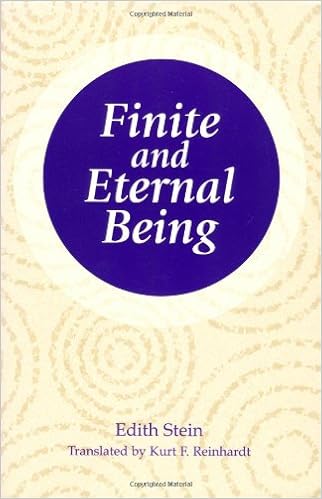
To understand this, I started to read her "Finite and Eternal Being"...

From the outset, I was so deeply intrigued by this book, that I decided not to comment on it, but rather to collect the thoughts and ideas I found interesting. So, this post is a collection of quotes from Edith - quotes I collected while reading it. I found it intellectually more honest than trying to comment on something I still need to understand better than I do now....


To begin, let's see her own, deeply honest admission, made in the introduction to the book:

"This (...) seems especially appropriate in the case of the author of this book: Her philosophical home is the school of Edmund Husserl, and her philosophic mother tongue is the language of the phenomenological thinkers. She therefore uses phenomenology as a starting point to find her way into the majestic temple of scholastic thought."

I'm excited to discover how does she go along that path ...

First discovery is ... of the amazing clarity and objectivity Stein approaches philosophy with a deliberate distancing from faith and religion. The rigor she is applying to that distinction, comes, from St. Thomas Aquinas himself, and from many of thinkers of the "thomistic" tradition, like Jacques Maritain.

When writing about the goals and functions of philosophy she says:

"It is one of the function of philosophy to elucidate the fundamental principles of all the sciences"
However, when she goes into the relation between philosophy and a religious doctrine, she remarks:

« Whatever derives from the synthesis of theological and philosophic truth bears the imprint of this dual source of knowledge, and faith, as we are told, is a "dark light". Faith helps us to understand something, but only in order to point to something that remains for us incomprehensible. Since the ultimate ground of all existence is unfathomable, everything which is seen in this ultimate perspective moves into that "dark light" of faith, and everything intelligible is placed in a setting with an incomprehensible background. That is what Erich Przywara means when he speaks of a reductio ad mysterium.»
The intro, and its chapter "Is there a Christian Philosophy" is an amazing proof of the author intellectual honesty. Now, to the essence ...

Thursday, July 09, 2020

Trzy dni przed wyborami | Three days before the elections

==PL==
Dziś jest 9 lipca 2020. Za trzy dni mamy drugą turę wyborów prezydenckich w Polsce. Jaka jest ich waga? Co jest w tym wyborze najważniejsze?

Z wielu, zapewne taktycznych powodów, to co najważniejsze nie jest zbyt mocno w tej kampanii uwypuklane. Być może tak miało być, być może najważniejsze sprawy nie interesują większości wyborców...

Nie chcę o tym pisać, nie chcę pisać o kompletnie wydumanych i zastępczych "ważnych" tematach w przekazie Andrzeja Dudy. Nie chcę udowadniać, że to, o czym mówi Rafał Trzaskowski jest ważne.

To, co w tej kampanii nie jest mocno dyskutowane to sama esencja demokracji w Polsce. Andrzej Duda przyłożył rękę do poważnego naruszenia jej podstaw - zasady trójpodziału władzy. Zaakceptował poddanie Trybunału Konstytucyjnego funkcjonariuszom PiS. Przyczynił się do zdemolowania Krajowej Rady Sądownictwa, do niewłaściwego wyboru prezesa Sądu Najwyższego w Polsce. Nie wspomnę już w wielu innych aktach tej władzy, jakich celem jest jedno: zakończenie w Polsce czasu Państwa Otwartego i Transparentnego. Zaakceptował niebotyczną pomoc dla Telewizji Publicznej, która od dawna jest skrajną tubą propagandową partii PiS, cyniczną do tego stopnia, że łagodne uwagi ze strony Rady Etyki Mediów kwituje jawnym kłamstwem, tak co do intencji Rady jak i swojej nieuczciwej działalności. Jest 100% pewności, że wybrany po raz drugi będzie kontynuował te działania. Nie ma co do tego żadnych wątpliwości.

Wiemy z historii zbyt dobrze, do czego to może doprowadzić. Z jednej strony do gigantycznych afer, jakich nigdy nie da się odsłonić (jak np. to co się stało z KNF albo z finansowaniem zakupów przez ministerstwo finansów czy też z niewyjaśnioną do dziś sprawą Skoków, "dwu wież" i wielu innych).

Ale i to nie jest nawet najgorsze w skali całego Państwa. Zdemolowane państwo, które nie szanuje zasady absolutnej niezależności filarów władz - kończy tam gdzie skończyły kiedyś w XX wieku Niemcy, Włochy czy Austria, albo, w najlepszym wypadku staje się atrapą demokracji jak Rosja za Putina, Węgry za Orbana, Turcja za Erdogana - aby już na tych tylko przykładach skończyć i nie iść za daleko.

Dla tych, którzy nigdy by nie wybierali Platformy Obywatelskiej w normalnych wyborach powiem tak - rozumiem Was i szanuję, ale pomimo to proszę - zastanówcie się nad tym, co jest "powyżej" polityki. I z tego powodu, nawet jeśli macie opór przed wyborem typu "mniejsze zło" - warto nawet z takiego motywu wybrać przeciwnika Andrzeja Dudy.

Stawka w tych wyborach jest najwyższa od wyborów z 1989 roku...

==EN==


Today is July 9th, 2020. In three days we have the second round of presidential elections in Poland. What is their significance? What is the most important matter in this selection?

For many, probably tactical reasons, what is most important is not highlighted too much in the campaigns of the contenders. Perhaps it was supposed to be like that, maybe the most important issues are not of interest to most voters ...

I do not want to write about it, I do not want to write about completely invented and substitute "important" topics in the message of Andrzej Duda. I do not want to prove that what Rafał Trzaskowski is talking about is important.

What is not discussed in this campaign is the very essence of democracy in Poland. Andrzej Duda put his hand to a serious breach of its foundations – to the principle of the separation of powers. He accepted the submission of the Constitutional Tribunal to PiS officers. He contributed to the demolition of the National Council of the Judiciary (KRS), and to the faulty choice of the president of the Supreme Court in Poland. I will not mention in many other acts of the presidential power whose purpose was simple: to end the time of Open and Transparent State of Poland. He accepted the sky-high help for Public Television, which has long been nothing more but an extreme propaganda tube of the PiS party, so cynical that even mild remarks on the part of the Media Ethics Council were met with blatant lies, both about the Ethics Council's intentions and  public TV station dishonest activities. There is 100% certainty that in his second term he would continue these activities. There is no doubt about it.

We know from history too well where this can lead to. On the one hand, to gigantic scandals that can never be revealed (such as what happened to the Polish Financial Supervision Authority or the recent financing of medical purchases by the Ministry of Health or the unexplained case of “Skoki” Shadow Banks, "Two Towers" scandal in Warsaw and many others).

But this is not even the worst on the whole country scale. A demolished state that does not respect the principle of absolute independence of the pillars of government, ends where it once ended in the 20th century Germany, Italy or Austria, or, at best, becomes a dummy democracy like Russia under Putin, Hungary under Orban, or Turkey under Erdogan - to end here with such examples and not to go too far...

For those who would never choose the Civic Platform in normal elections I will say – yes, I understand your motives and respect you, but please - think about what is "above" the politics. And for this reason, even if you resist choosing the "lesser evil" – in this very elections choosing Andrzej Duda's opponent is a noble act despite the unwanted motive. 

The stakes in these elections are the highest since the 1989 when we broke with communism...

(The picture from: https://telanganatoday.com/pillars-of-democracy-are-fraying)

Wednesday, July 08, 2020

Republican voters against Trump


Polish right-wing president and his wife are surely not happy to be shown in a negative context in the Republicans Voters against Trump spot...
Particularly before the elections in Poland....


From:

Saturday, May 23, 2020

The court is not a premise for rent by politicians

This is Google Translated text of the Supreme Court Judge and the Professor of Jagiellonian University Włodzimierz Wróbel.
The original text is here.

The court is not a premise to rent by politicians. Judge Wróbel's words vibrate like a remorse of those in power... 


My name is Włodzimierz Wróbel, I am a judge in the Criminal Chamber of the Supreme Court and at the same time I teach criminal law at the Jagiellonian University. We already know that we operate outside the mode, it also turned out today that this mode will end in nothing, which is why the chairman declared that he would not exercise the constitutional competence of the body in which we were and would not vote on the resolution on the performance (as the chairman said), the President of the Republic of Poland, candidates for the first president of the Supreme Court.

If this was a normal procedure in which such candidates were to be selected, then I would probably shudderly tell you about my vision of the Supreme Court, what should be changed, what should be improved, how should it work and probably would not be here in the room or cameras, nor would anyone be interested in it.

I will make this statement a little different. We think that here are the walls in this room, but this room has no walls. Thanks to the decision that we have media access, we have a transparent process, citizens are watching us. I know that my students are also watching me. During the pandemic, instead of normal lectures, we did talk about law and I know that now my seminarians - Andrzej, Kuba, Monika, Mikołaj - listen to this on Facebook. I invite you now to talk about what is happening here.

A tiny constitutional body, one tiny provision

We are in the hall where the general assembly of SN judges is taking place. It's a tiny constitutional body. One small constitution provision. He says that this assembly is to present the president with candidates for the post of head of the main court in this country. Of course, there are many such judgments, we can tell each other that everyone has their own powers, but we know the meaning of the Supreme Court. This is a key position. It can change any judgment of a practically different court.

The head of this court also has a huge position, regardless of how he can organize the work of the Supreme Court, let us remember that he is the head of the State Tribunal, the court that judges the authorities.

A tiny constitutional body, one tiny provision that says that this assembly is to present candidates. The creators of the constitution knew why this provision sounds this way.

Because they knew that every power, no matter what color it is, has a huge snatch to court, because the courts are the only independent, impartial institution that has this power to control. It is to defend the citizen against abuse of this power.

And it is known that there has always been and will be tension between political power and the courts, no matter who rules.

Those who wrote this constitution invented such a mechanism of mutual control, check and balance - say the English. Namely, judges cannot call their own bosses, they must present five candidates, and Mr. President cannot, according to the constitution, simply send to the Supreme Court whom he wants, a politician or a lawyer and make him the head of this institution. You have to get along. You have to communicate.

What is the agreement about? And the fact that the assembly is to present, today the law says, five candidates and from them the president is to choose one and appoint as the first president of the Supreme Court. A simple provision, the act repeats.

Why is this so important? Therefore, that the Supreme Court would not become another political prey, especially when there is increasing social and political tension, such a huge temptation exists to win more independent institutions, to free them, to make them dysfunctional.

Two sentences that shook the judge
So what is happening now, what are we dealing with now? There are two sentences that I am asking you - and I am talking to you, my seminarians, I am talking to you here, I am talking to everyone who listens to me - I was shocked by the two sentences I heard recently.

The first sentence of a prominent politician of the currently ruling party, but it could probably be that of any other politician. He said that in a moment the last bastion will fall, he thought about this event in which we participate, about the general assembly that is to choose the candidates for the first president. Of course, the whole Supreme Court was implicitly implied - this is where the last bastion will fall. But the sentence, which was even more shocking to me, is such a conversation, Mikołaj, remember, you once asked if it is worth being a judge in this country, is there sense? Do you have students, would you like to hear such a sentence from a law student, a young man?

Ladies and gentlemen, what is this gathering for, why are we sitting here, why are we arguing and arguing? That is why we want this bastion to remain as a bastion of justice, and not just become - I don't know - a place to rent by politicians, a caravan where everyone can sit and spend some time. Or in which you can give away elite jobs. That's what this constitutional fuse is for.

The second part of the lecture, the second part of our conversation. A recipe for how such institutions are taken over. This is a very important moment when it is worth talking to lawyers about the legal system, because these independent institutions, such as the court, what is supposed to protect citizens,

that the court was not yours or ours, I go back to that phrase non-stop, only to court was an independent state, no matter what political power in this country is governed.

There will always be tension and there are always ideas on how to appropriate independent institutions. Recipe? You know him very well. What is done first? First, a film is made, judges are turned into beasts, castes, communists, thieves, judges do not have the habit of speaking, they speak with judgments. This situation in which this media attack, a political attack, surprised many. They couldn't say much. Was the justice system functioning well? Sure not. Should that justice just be plowed and say that it doesn't make sense?

Ladies and gentlemen, nothing gives such great satisfaction as the opportunity to unleash authority in the mud. This is a great mechanism. This is the first element.

How is the independent state institution taken over? Procedures are invented, on which politicians mainly influence, political institutions such as the National Court Register are created, which are chosen by politicians themselves, a law is created so that the final decision is always made by a politician and lawyers are often sought, who are often with good will and good will with intention, and often without good will and good intention, they will enter this political plan.

Who will such a president be?
What happens next? We can still see it in this room. We are already beyond any procedure. There is a general assembly, there is a collegiate body, whether someone is being nominated politically who will be the head of this body, after all this is a presidential nomination, you can choose any person. And suddenly it turns out that this constitutional body is not the General Assembly, but the chairman of the proceedings, who decides everything, prejudges everything, says what the law looks like, issues ordinances on how we should discuss whether we will throw into the box or we can verbally ask anyone, we are out of mode.

Finally, it turns out that this procedure is also to end with nothing, it is to be torpedoed, in fact it does not come to what this procedure is to end.

So what happens next? Ladies and gentlemen, this question is the most difficult to answer. I could not explain to you, what I am saying to my seminarians. After all, it is known that nobody will trust such a court, which will be taken over by politicians. He will not be effective, he will not be able to settle disputes, because he will be our court, but not a joint court.

Who will be the president elected in such a procedure?

I do not know, we are still in a phase that has not ended, but from the chairman's statement to this wall, we are heading to this catastrophe, i.e. such an illegal procedure of presenting candidates to the president. Will the president call? I hope not, but maybe he will. And how will it end? Will I be the president of the Supreme Court whom no one will recognize or only a part will recognize? Will I the president of the Supreme Court, who will change any political change, this one, no one, today, tomorrow, in a month, in two years, in three years, in three years, and then another political power will sweep him out again.

We want the first president of the Supreme Court who, when he wonders where he can go abroad, will see only one neighboring country who will be able to accept him?

I don't know, I can't answer the question, what is all this for? Maybe you will be more implied here I am talking to my students.

And the third topic, what are the meetings for, what is really going on here and who is here? Lawyers are sitting in the room. Judges with many years of experience are sitting in the hall. There are academic lecturers and judges in the room who also have such academic experience. There are now citizens outside this room who the police have IDs for. We will leave this room and you judges will have to sit at the judge's table and look into the eyes of citizens who will wonder regardless of your intentions and regardless of your belief in independence, they will wonder whose court you are. And academic lecturers will have a much more difficult role, Professor, because you will have to stand in front of students and tell what happened here.

Mikołaj, don't give up, don't give up being a judge. Don't give up being a lawyer, because it's a profession where you have to fight for others. How? Fight for community, fight for the state.


The Tragedy of Ideas: How intellectuals lead history astray ...

It is often assumed that philosophical, psychological, sociological, and literary works cannot be held responsible for what later unfolds in...